
 200
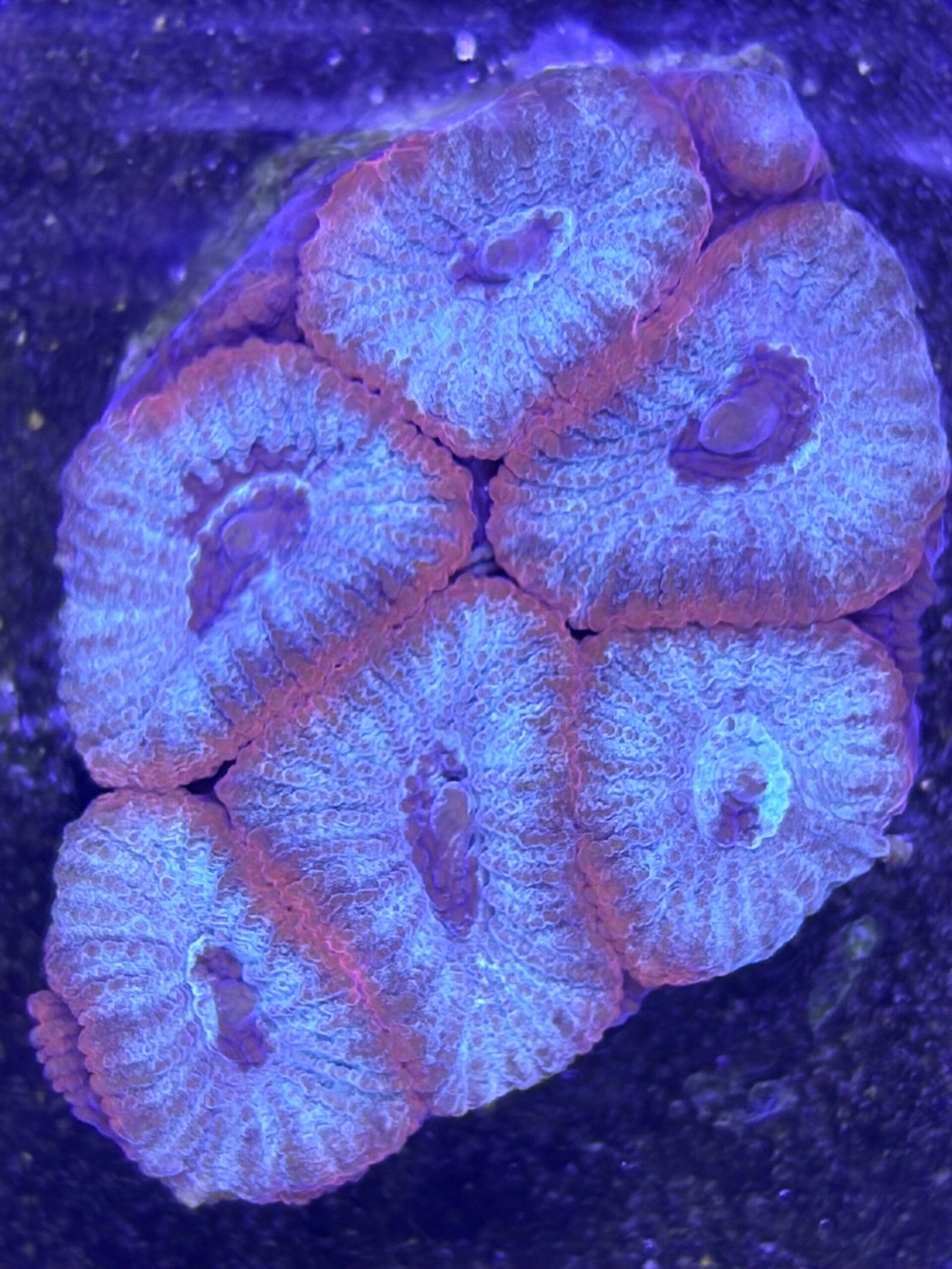
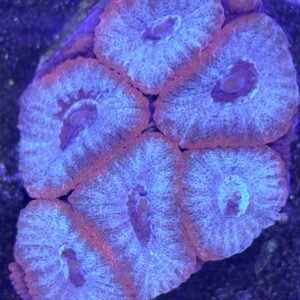
Micro Favia (primarily referring to Micromussa amakusensis or small-polyp Favites variants) is a popular LPS (Large Polyp Stony) coral prized for its tightly packed, intricate corallite structures, intense color morphs, and fast encrusting growth habit.
Because its polyps are significantly smaller (3\text{ mm} – 7\text{ mm}) than standard Favia or Dipsastraea species, Micro Favia forms a smooth, high-density carpet across rockwork rather than bulky, rounded brain-coral mounds.
Quick Stats
Care Level: Easy to Moderate
Temperament: Semi-Aggressive (Short feeder tentacles)
Lighting: Low to Moderate (50 – 120\text{ PAR})
Water Flow: Low to Moderate (Turbulent)
Placement: Lower half of the tank or bottom rockwork
Photosynthetic: Yes
Supplements: Calcium, Alkalinity, Magnesium, Trace Elements
Lighting & Placement
Lighting: Thrives in low to moderate light (50 – 120\text{ PAR}). Under high PAR or direct unfiltered light, the vibrant colors can bleach or darken defensively.
Placement: Mount on low-lying rockwork or flat substrate. As an encrusting species, it will creep over and cover adjacent live rock, so give it room to expand away from aggressive neighbors.
Aggression: Possesses short feeder/sweeper tentacles compared to standard Favia, but it can still sting immediate touching neighbors. Leave a 1 – 2\text{ inch} safety perimeter around the colony.
Water Flow & Feeding
Flow: Requires low to moderate, indirect flow. Flow should be strong enough to keep detritus from settling between its fine corallites, but gentle enough to allow full fleshy polyp expansion.
Feeding: Photosynthetic via zooxanthellae, but responds very well to target feeding. Because the polyps are small, feed fine particulate particulate foods, micro-pellets, reef roe, or dissolved amino acids 1–2 times per week when feeder tentacles extend (typically shortly after lights-out).
Ideal Water Parameters
Temperature: 75^\circ\text{F} – 80^\circ\text{F} (24^\circ\text{C} – 27^\circ\text{C})
Salinity / Specific Gravity: 1.024 – 1.026
pH: 8.1 – 8.4
Alkalinity: 8 – 11\text{ dKH}
Calcium: 400 – 450\text{ ppm}
Magnesium: 1250 – 1350\text{ ppm}
Nitrate (\text{NO}_3): 3 – 10\text{ ppm}
Phosphate (\text{PO}_4): 0.03 – 0.08\text{ ppm}


Reviews
There are no reviews yet.